Watching, Feeling, Remembering
Nostalgia, time-travel, and the tangibility of appointment television

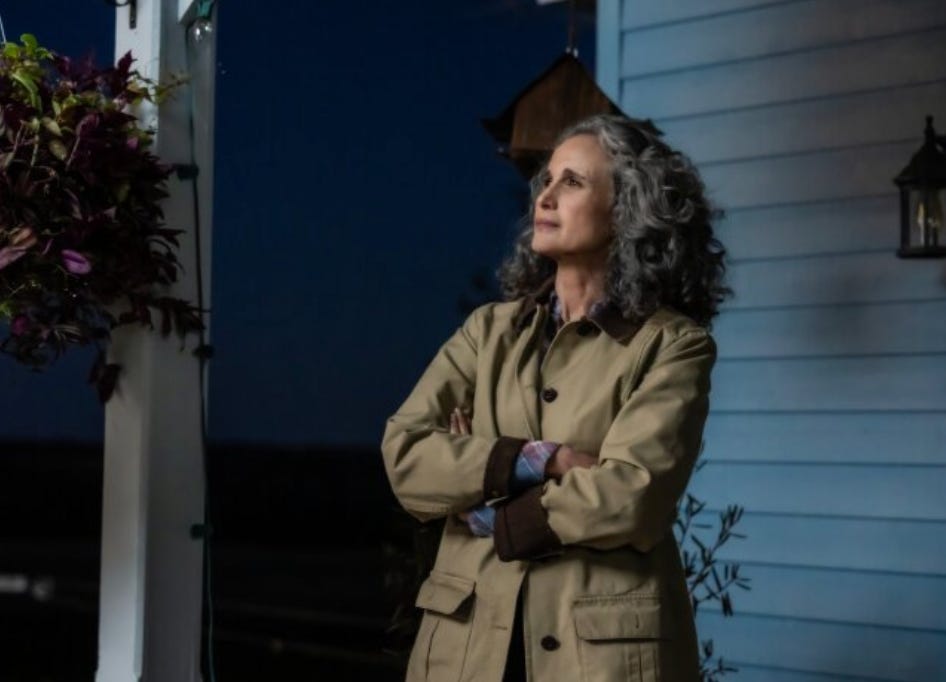
“The jumbling up of time, the montaging of earlier eras, has ceased to be worthy of comment; it is now so prevalent that it is no longer even noticed.” – Mark Fisher
In the age of streaming, less stream than the bog we sift through for rare gems and the shards left by unjust cancellations, who would have guessed that a Hallmark production would save us?
The Way Home is a throwback, not just to old-school melodrama, but the kind of watercooler appointment television that doesn’t apologize for its emotional manipulations. Watching it feels like running your fingers over the cover of a drugstore paperback, the embossed kind with a girl fleeing through the moonlit woods—a girl does just that in the show’s opening scene. It’s over-the-top and clunky in parts, adhering firmly to the brand’s tropes even as it winks at its audience. But beyond sheer enjoyment, it feels like an analog haven amid a mire of digital flotsam.
The plot, as such, follows the relationships of three generations of women: Del, Kat, and Alice (played by Andie MacDowell, Chyler Leigh, and Sadie LaFlamme-Snow), whose already strained relationships are worsened by a refreshingly lo-fi time-travel device. “There’s a pond in those woods,” MacDowell’s matriarch tells a disaffected and very disinterested Alice, “more of a sinkhole.” “Charming,” the teen replies.
But fall into that pond, as she soon discovers, and you’ll be spit out in another timeline for some unresolved family trauma. And the Landry women are teeming with it: a child who went missing two decades ago, the untimely death of a beloved patriarch, and, of course, a divorce-in-progress (Kat) because we can’t not have a big-city career woman tossed back to the nest to flirt with the boy next door. Rounding out the turmoil is Alice, who will take more dips than your average Doctor Who companion. A disarmingly simple setup, but the show takes its time travel logic seriously, evading the traps that so often landmine the genre.
Mysteries simmer into melodrama but never outstay their welcome. Throughout its three seasons (soon to be four), the growing cast has cycled through buried secrets and unrequited loves, entangling past and often long-dead actors in threads that are always already unraveling. The result is tear-jerking, heartwarming, and the kind of camp Sontag might call “pure”— more on the naïve side than the self-aware. As a friend and fellow fan remarked, “It does make me cry, just never when it’s trying.”
Amid all this intergenerational angst, however, lies another, perhaps more compelling reason that the show resonates so strongly with viewers. Kat, Alice, and the burgeoning cast of pond-jumpers may captivate us in their search for closure, but there’s a pull too in how the show’s presentation of its time travel elements grapples, albeit less directly, with our growing sense of material and temporal dislocation.
By design, and a happy accident of budget, the series remains firmly moored in the physical. A grudging amount of CGI is employed to de-age the actors in the past, but there’s a refreshing lack of fantasy sparkles or glowy objects used to glam up the magical elements. The pond is a pond is a pond, and the characters emerge from it rumpled and soggy, leading one to suspect that half the budget goes toward resupplying the wardrobe. I flinch every time Kat hurls herself into the murk in a wool coat, or, for god’s sake, suede.
The mysteries are anchored in objects: old notebooks, timepieces, and the analog media that serves as an emotional ansible between generations. When Kat stays late at the paper to investigate her brother’s disappearance, we aren’t shown a montage of screenshots and scrolling headlines, an easy expositional device given that he disappeared in 1999; instead, we see her leafing through the archives of the local paper, her fingers running over ink and the grainy texture of newsprint, a body negotiating a world page by page. There’s nothing slick in the way of today’s Netflix dramas, which make every movement feel precision-engineered to milk a reaction, but rather an almost antiquated stiffness to the show’s opening exchanges, the blocky crowd scenes, or just the artlessness with which the characters move through space. Though the plot moves quickly enough, there’s a hint of the protractedness of the daytime soap opera, whose actors Joan Didion once remarked moved as if underwater.
This is by no means a criticism; the show draws a gentle, visceral comfort from that very lack of polish, and the unselfconsciousness with which it reveals the sturdy rhythms of old-school TV craftsmanship. When we watch a film, writes Jennifer Barker, we experience it in our bodies “as much as in our minds, the exhilaration of a ‘close call’ or the intimacy of a close-up … we and the film have a muscular empathy for one another, which is derived from similarities in the ways the human body and the film’s body express their relation to the world through bodily comportment.” The Way Home’s insistence on characters who search, feel, and touch, sometimes with an ungainly sincerity, reaches beyond mere nostalgia for something, dare I say, more human.
Its embrace of pre-digital media is not in the self-aware mode of a cineaste but earnest and emotionally connective. Describing our fascination with the analog, Jan Tumlir argues that we’re “compelled by a nostalgic fetish for a still-embodied technology, one that shores up a warmth that gradually dissipates as we approach the present.” It’s this very warmth that The Way Home cultivates: the sheet music, vinyl records, and portable CD players are less of a cassette-punk aesthetic than a means to evoke the lost connections between family, friends, and time-crossed lovers.
The music they contain is the clearest expression of this impulse, with pop songs serving both temporal signposts and fixed points of connection between Alice and the characters she encounters in the past. ‘90s hits forge her friendship with the teenage Kat, and later — make that two decades earlier — her grandfather, Colton, when they collaborate on a demotape that finds its way to the present. While these songs conjure viewer nostalgia, they also echo our strange disconnection with the current soundscape, or what critic Mark Fisher termed “the slow cancellation of the future.” A modern pop song beamed back to the ‘90s, he suggested, would shock those listeners not for its unfamiliarity, but “the very recognisability of the sounds.” He writes: “It doesn’t feel as if the 21st century has started yet. We remain trapped in the 20th.”
Alice might be an avatar of this cancellation. A product of the 21st century, she is nevertheless compelled to return to the past and inhabit the personal and cultural moments of the 20th. Her youthful ambition to be a singer, while plausible as a character trait, also stretches credibility for an audience that has witnessed that possibility erode for all but a few. Her journeys back might then be interpreted as quests to reground those sounds, realigning them with the lived experiences that originally gave them meaning.
If Dark Academia evokes nostalgia for the tactility of musty tomes and ink and paper, then The Way Home might be called the Domestic Arcane, its fantastic elements nudging it beyond the network’s Crate & Barrel aesthetic, tapping into a longing for the ways we used to inhabit space. The period sets and pop songs are merely a lure, promising nostalgia but offering an older physicality in the storytelling, a thereness of the television experience that, for an hour a week, reminds us of our bodies and the way they, and we, once felt immersing ourselves in a story.
The rough and awkward bits are part of the charm. They might just be the point.